The multi-sensory feedback is also used in computer games. Since the beginning computer games used two ways of providing a user with feedback – sound and video. In 1985 a first attempt to add touch sensors (haptics) was made by SEGA. It was integrated with their game called Hang-On and it was a motorbike that you had to sit on and lean right/left in order to turn. It also had complete handlebars with throttle and break lever.

Figure 1: Hang-On screenshotSource:
It used visual, sound and haptic feedback in order to provide a user with better experience while playing the game. One of the reviews by Brett Alan Weiss states that “Although available in a standard upright cabinet, Hang-On must be played using the deluxe sit-down model to be fully enjoyed. This device despite being very old had great usability and was highly regarded by players. In present times there are much more multi-sensory interfaces implemented in games. They are using various pads (e.g. Playstation 2 with force feedback), Microsoft Sidewinder Force Feedback joystick or Logitech Racing Force Feedback Wheel and Pedals set.
Figure 2:MicrosoftSidewinder Force Feedback joystickSource: http://www.cs.unc.edu/~stewartm/images/joystick.jpg

Figure 3: Logitech Racing Force Feedback Wheel and Pedals
Together with visual and sound effects they are used to create a more realistic game experience. In racing games the wheel reacts differently for each surface and maneuver that user performs. It is the same with joystick and flight simulators – it can simulate bad weather conditions and turbulences. Such devices generally get great usability ratings. Shane McGlaun from about.com when reviewing one of the force feedback wheels writes.
Playing games that support force feedback with the Logitech MOMO Racing Steering Wheel is cool in the extreme. The addition of force feedback makes the games seem so much more realistic and makes driving games much more fun. The force feedback action helps you to feel what your vehicle is doing on the track, very much like you would feel in a real car if you were driving.
It is exactly the same with joysticks used for flight simulators. One of the product reviews from amazon.com states:“I am a pilot, and this is about as real as you can get without a yoke and pedals. You can even feel the cracks in the pavement as you zoom down the runway. The throttle is a bit small, but other than that, I love it!”Those examples show how far multi-sensory feedbacks (video + sound + haptics) can improve the usability of a game. Most of the users like it.Unfortunately there are also some problems with it. There are few constraints that need to be taken into consideration. Those constraints are cost, time and portability. Giving a user more output, from the virtual environment, can be beneficial but it can also annoy him. Imagine playing a car game with a wheel that has force feedback. In the beginning it seems to be fun and pleasant, but after spending more hours, the vibrations are becoming inconvenient.As Yasuhisa Kato from University of Stanford writes.
The joystick simulated the vibration of the engine. As the speed increases, the vibration was getting bigger. It was very annoying during the concentration on the driving.
This is a point which needs to be considered by designers of such devices. A lot of tests need to be performed in order to classify which feedback is beneficial for the user and which annoys him. That’s why most devices are now configurable.The cost is also important constraint. As an example we can look at the Sony’s replicas of Mitsubishi Lancer to give a user an experience of driving a real car.

Figure 4: Mitsubishi expositionSource:
http://www.gizmag.com/picture/hero/3833_01.jpg
http://www.gizmag.com/picture/hero/3833_01.jpg
Development of it cost AUD$250,000. It lets users play a playstation game – Grand Turismo 3. The experiences are extremely pleasant but the cost involved was very high. Developing such technologies absorb a lot of time.Multi-sensory feedback is also used to train pilots. Virtual cockpits are prepared for them in order to improve their skills before entering a real machine. Multi sensory feedback is extremely useful in this situation as it provides better feel of realism of the test machine. Its usability is also very high, as it reflects the exact plane controls and presents high quality textures.

Figure 5: A training cockpitSource:
http://www.confederationc.on.ca/ace/images/Frasca-B58-Beech-Baron-cockpit.jpg
http://www.confederationc.on.ca/ace/images/Frasca-B58-Beech-Baron-cockpit.jpg
Visual, sound and haptics interfaces additionally provide a vital tool for surgeons. In future such technology could allow performing surgeries on great distances. At the moment it can be used to simulate an operation and for training purposes. As we can read on the pages of Ecole Polytechnique Federale de Lausanne “Virtual-reality based surgery simulation opens up new fields in medical training and education.

Figure 6: Presentation of multi-sensory interface simulating an operationSource:
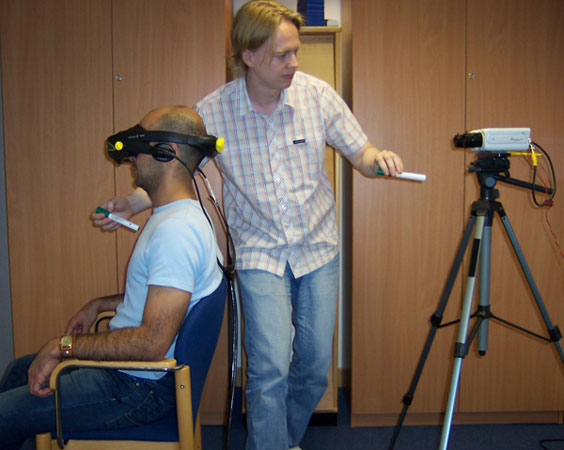
Multi sensory feedback can be also used to stimulate the “out-of-body” feeling. Michael Persinger from Laurentian University in Canada did an experiment so as to simulate a feeling of virtual reality. He used a 3D camera with goggles, sound and haptics in order to achieve the desired effect. ‘"Wow!" giggled one subject. "I felt as though I was outside my body and looking at myself from the back!"’. It was evaluated by the test participants as very interesting experience.

Figure 7: Michael Persinger during the experiment.
http://www.youtube.com/watch?v=MPG-LYoW27E&feature=player_embeddedSource:
http://img.slate.com/media/17/070823_Sci_ExperimentEX.jpg
http://www.youtube.com/watch?v=MPG-LYoW27E&feature=player_embeddedSource:
http://img.slate.com/media/17/070823_Sci_ExperimentEX.jpg
Near Coventry (in Staffordshire) in the Shire Hall Gallery a multi-sensory room was opened. It consists of musical hand wall, interactive bubble tube, pinspot projector, mirror ball, infinity tunnel and sensory drawers. It can be used for therapy, relaxation or to stimulate learning and development. A survey was made among the people that visited this room.
The results showed that:
98% of users said that they enjoyed their visit
100% said that they would come again
42% of users rated it as ‘excellent’
47% as ‘great fun’
11% as ‘good’
Some of the user comments:
The Multi-Sensory Room is a fantastic idea and much appreciated. I'm sure it will be beneficial to lots of people and I hope it proves very successful. The kids really enjoyed themselves exploring and I found it relaxing!As the survey shows the usability of this room was highly regarded by the participants.

Figure 8: Music creation hand wallSource: http://www.staffordshire.gov.uk/NR/rdonlyres/7919BC43-2691-4AA2-9ADD-2C9C93C16C2D/45345/Musiccreationhandwall.jpg

Figure 9: Interactive infinity tunnelSource:
Generally the research into multi-sensory feedback can bring us not only the benefits of making some experiences (e.g. video games) more pleasant and realistic. Can you imagine machines (e.g. aircraft fighters) being controlled by human remotely, without risking his life. A surgeon performing operation on a distance of many miles going into virtual reality to relax, better understand a given technology/process or fight with your fears? All of this is already possible or a very near future, and multi sensor feedback is extremely vital in all of these situations. We are looking forward to its development.
References:
Engber, D. (2007) The Out-of-Body Electric [online] available from http://www.slate.com/id/2172694/pagenum/all/ [23 August 2007]
Kato, Y. Force Feedback devices [online] available from http://ldt.stanford.edu/~yasukato/portfolio/class/cs147/as8/
Gizmag (2005) The World’s most advanced (and expensive) Sony Playstation peripherals [online] available from http://www.gizmag.com/go/3833/ [11 March 2005]
Amazon.com, Inc. (2002) Customer Reviews Microsoft Sidewinder Force Feedback 2 Joystick [online] available from http://www.amazon.com/review/product/B00005NIMB/ref=cm_cr_pr_hist_5?%5Fencoding=UTF8&filterBy=addFiveStar [7 January 2002]
McGlaun, S. (2008) Logitech MOMO Racing Steering Wheel [online] available from http://peripherals.about.com/od/gamingperipherals/fr/momoracingwheel.htm [2008]
Weiss, B. (2008) Hang On: Synopsis [online] available from http://www.allgame.com/cg/agg.dll?p=agg&sql=1:10234 [2008]
Aviation Centre of Excellence Flight Simulator Training [online] available from http://www.confederationc.on.ca/ace/simulator.asp
EPFL (2008) A Flight Simulator for Surgeons [online] available from http://lsro.epfl.ch/page65765-en.html [2008]
Staffordshire County Council (2007) Multi-sensory room [online] available from http://www.staffordshire.gov.uk/leisure/museumandgalleries/shirehallgalleries/mseroom.htm [26 November 2007]
Staffordshire County Council (2006) Feedback on the Multi Sensory Room at the Shire Hall Gallery [online] available from http://www.staffordshire.gov.uk/NR/rdonlyres/7919BC43-2691-4AA2-9ADD-2C9C93C16C2D/45321/FeedbackontheMultiSensoryRoomnovtodec06.pdf [December 2006]




No comments:
Post a Comment